How learning works here
Skills, worked through projects, across the physical, the mental and the emotional. Our name says it: क से काया, द से दिमाग, म से मन.
Not three subjects in three periods. One block, and all three in it at once, because a four-year-old does not arrive in parts. Open each colour for the skills we work on, and how.
काया Physical The vessel of thought, intent and action.
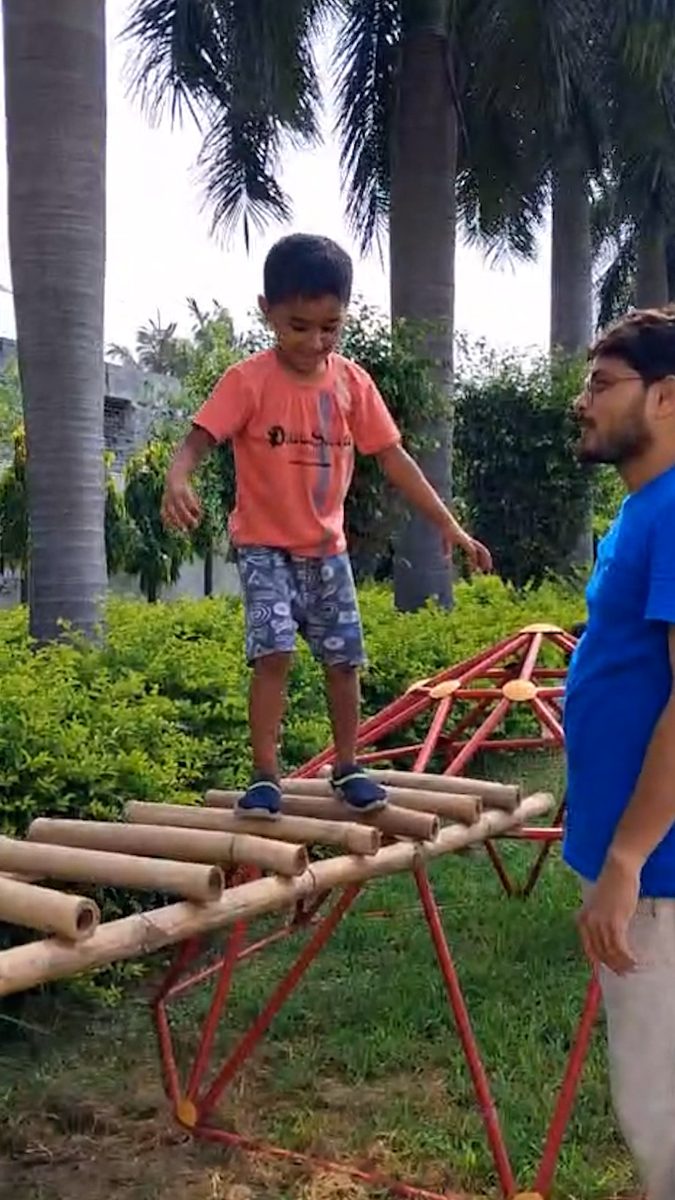
Our health and our habits shape what we think, and whether we can act on it. It begins with the big movements, walking, balancing, running, climbing, hanging, and goes on to the small ones: threading, cutting, pasting, drawing, buttoning a shirt. Later the two combine, in sport.
The skills we work on this year
- Running
- Hanging
- Jumping
- Catching and throwing
- Balancing
- Fine motor: threading, cutting, pasting, drawing
Every day starts with an hour of it. Structured play, free play, messy play, and risky play: a ladder, rings near the ceiling, a foam pit underneath, a child climbing, hanging and dropping. The adults make the ground soft and stay out of the way. The day has a shape you can read.
गेंद को 4 फीट दूर रखी बाल्टी में फेंकने के लिए 3 बार की कोशिश में, पहली कोशिश में 6 गेंद में से सिर्फ 1 गेंद बाल्टी में फेंक पाया, दूसरी कोशिश में 4 और तीसरी कोशिश में 5 गेंद बाल्टी के अंदर फेंकी।
A facilitator's note in one child's progress report, Nursery, 2025–26. Six balls at a bucket four feet away: one in, then four, then five.
दिमाग Mental The root of all innovation and all destruction.
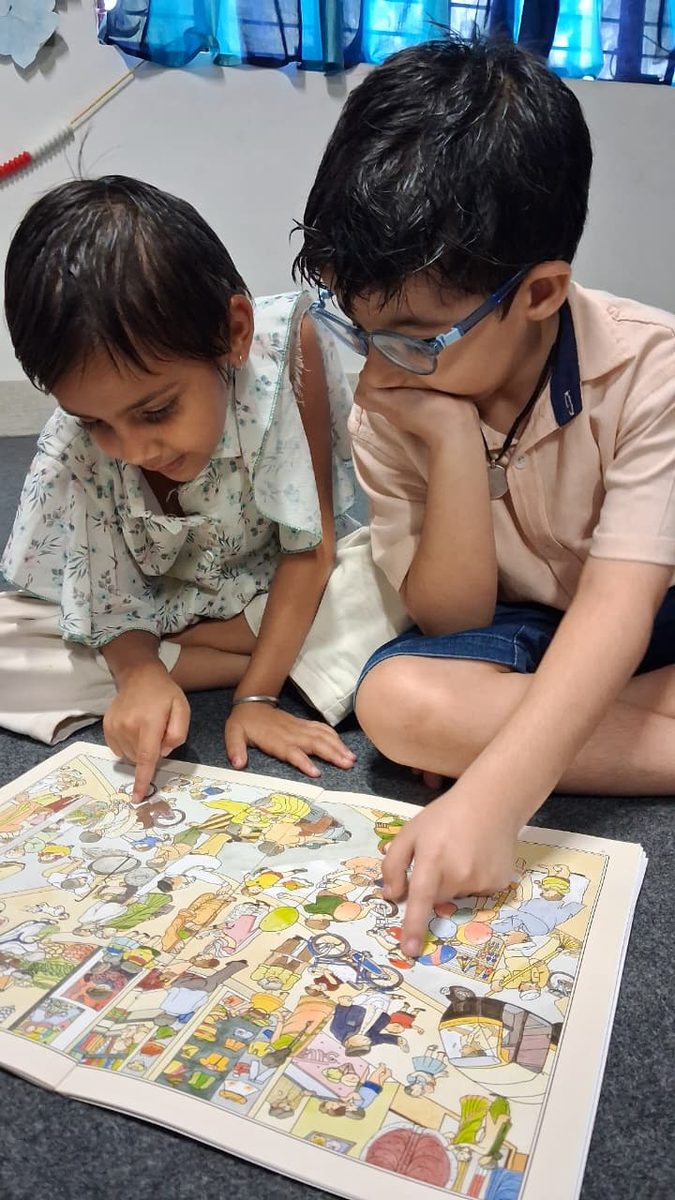
Memory, understanding, thinking, creativity, and the two we get asked about most: language and numbers. It starts with a child asking what is this? what is that? and grows into what can I do with this? how does the world work? Most subjects live here, and they turn up as the child keeps asking.
The skills we work on this year
- Memory
- Understanding
- Thinking
- Creativity
- Mathematics
- Language
Language. Hindi first, and English after. Stories are told aloud and written down exactly as they were spoken, uncorrected; six children told more than forty of them in one year, and we printed them. Speech is acquired and writing is taught, and it is taught once a child has run into the need for it. How a child learns language here, and the book, चटर-पटर.
Numbers. We do not ask children to recite them. How many bananas today, how many animals in the story. Adding and taking away inside a story before counting has settled. Beads in the hand first, then dots on a page, and the symbol last, when a child has met the need for it. How counting arrives.
खाना खाते समय संतरे की फांके गिन कर बोला- “ये चार है”। फिर एक-एक कम करते हुए बोला- “अब तीन रह गई”, “अब दो बची”, “अब बस एक बची”।
A facilitator's note in one child's progress report, Nursery, 2025–26. Counting the orange segments at lunch, four, and then taking them away one at a time. Nobody set him a sum.
मन Emotional Whatever we do comes from our relationship with ourselves, with others and with nature.
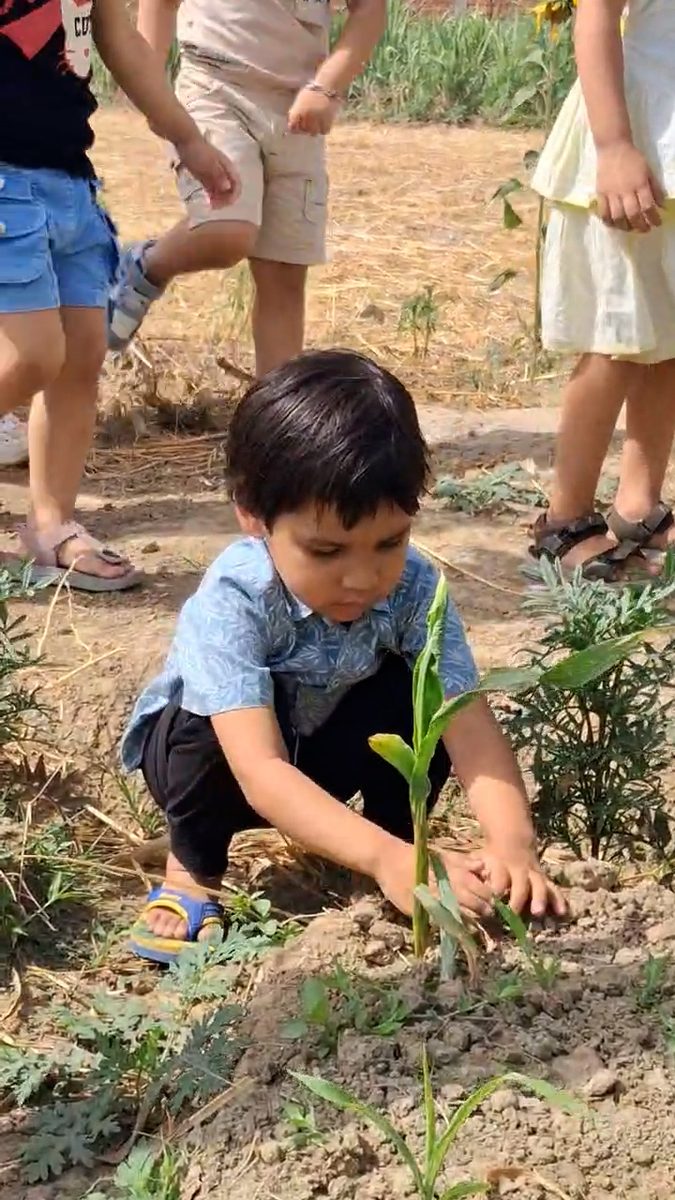
If the world is cruel, I can do whatever I want to get the most for myself. If I want the world to be kind and fair, I will be considerate, respectful and fair. It starts with knowing myself, and with how I handle what I feel.
The skills we work on this year
- Helping each other
- Sharing your own things
- Looking after materials
- Feelings, and control of the body
- Waiting for a turn
Three circles hold this. The morning circle, the lunch circle, and the closing circle, where every child sits down and talks about the day: what excited us, who helped whom, who we are missing. The facilitators' notes name the first and the last, सुबह का गोला and छुट्टी का गोला.
सुबह के गोले और छुट्टी से पहले वाले गोले में बैठकर, बीमारी के कारण स्कूल नही आने वाले दोस्त के लिये प्यार और ताकत भेजता है।
A facilitator's note in one child's progress report, Nursery, 2025–26. In the morning circle and the closing circle, he sends love and strength to a friend who is off school ill.
One block, all three at once
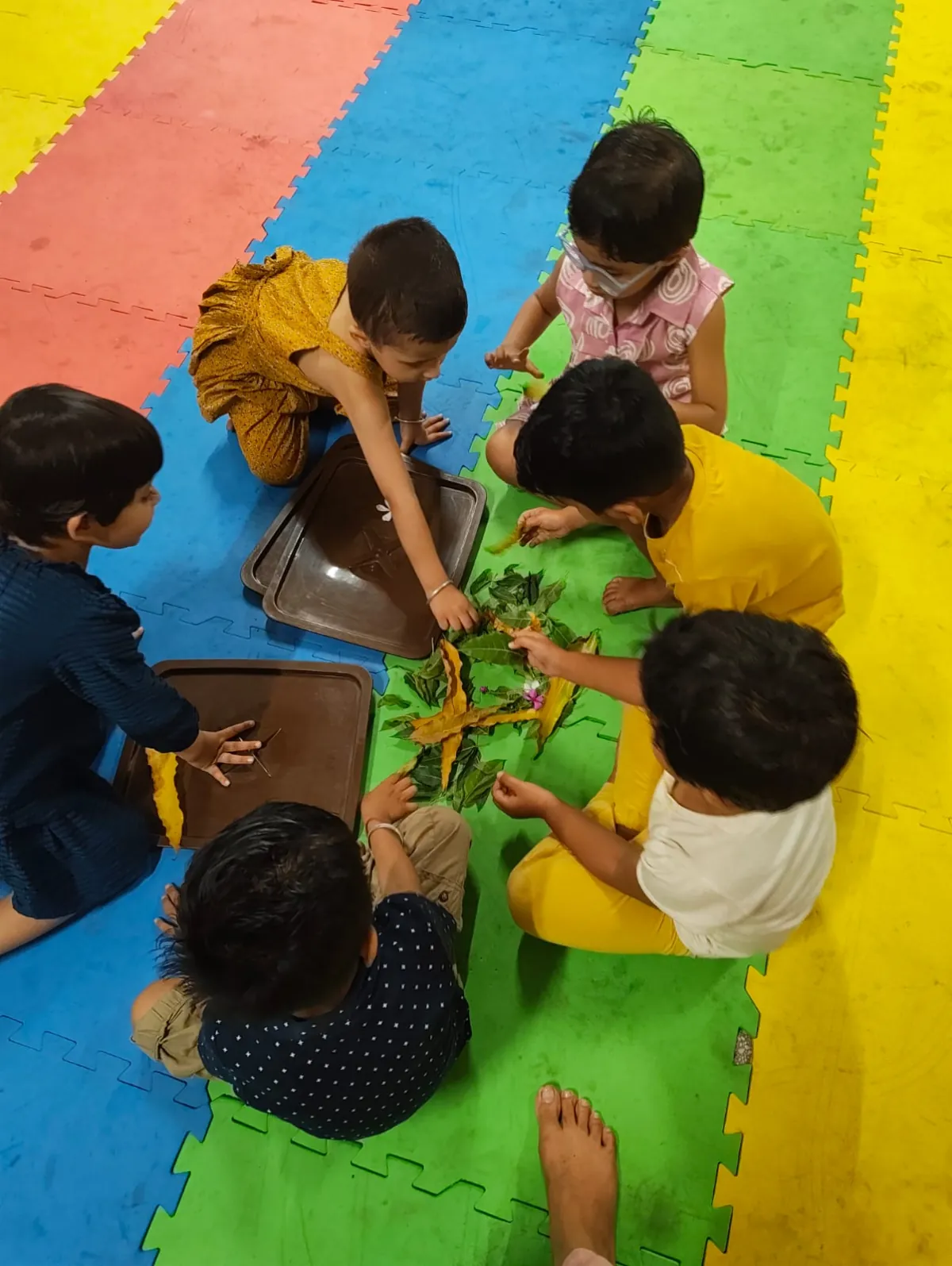
One July morning, after an hour of Physical and a fruit break, thirty children go outside to look for leaves under the Ashok trees. Big ones and small ones. They help each other find them, carry them back in, spread them out, sort them, answer the facilitator's questions about them, clean up before the session ends, run and jump around them, and sing a song about them.
That was the maths lesson, about big and small. It was also thirty children moving their bodies for an hour, and also a child noticing that a friend had not found a small one yet. We do not separate those.
Two rules sit under every block. Experience precedes exploration and expression, so a child does the thing before examining it, and examines it before being asked to say anything about it. And connection before context, context before content, because a child who is not yet with you cannot be taught anything at all.
What this is built on
We do not call ourselves a Waldorf school or an Integral school. We have not earned either name, and we would rather be accurate than impressive. What we do is learn from people who worked a lot of this out before us, and say so.
We are inspired by Gandhi's Nai Talim: the hand, the head and the heart together, and the self-reliance and self-sustenance of Hind Swaraj. By Rudolf Steiner: reverence, and rhythm. By Maria Montessori: self-directed learning, and an environment set up so that a child can direct it. By Sri Aurobindo and The Mother, and the three principles of true teaching: that nothing can be taught; that the mind has to be consulted in its own growth; and that one works from the near to the far, from that which is to that which shall be. And we continue to explore others.
India's own framework holds all of it. The National Curriculum Framework for the Foundational Stage, published by NCERT in 2022 under NEP 2020, says that play and activity are the primary ways of learning at this age, that learning must be in the child's mother tongue, and that assessment here should be observation and portfolio rather than written tests. Everything on this page sits inside that framework rather than beside it.
How we know what a child is learning
There are no examinations. Thirty children have three adults with them all day, and what those adults notice is written down. The next week is planned from it, after the children have gone home.
Once a year each child gets an Individual Progress Report. It is written for the parent, and it has no marks in it. It keeps two things apart: the effort a child is putting in, and how far they have come from their own starting point. Then pages of what the facilitators actually saw. A child is never behind; stages label chapters, never children.
What a note notices
A facilitator's note is small and exact. It says what happened, not what we think of the child, and most of it is what a child does when nobody has asked.
Walking on dry leaves by the sandpit, a child says they are making a pat-pat sound. After lunch, a child says, on his own, that he will help wipe the mat. A child who used to push into the middle of the queue now waits for his turn when asked once, or without being asked at all.
No single day shows that last one. A year of notes does, and it is what a parent sits down to read.
Examination, or observation: what a facilitator's note notices
Once a month there is a parents' circle, where we sit down with parents and go through what we are noticing. And any morning between nine and one you can come and watch, which is the one form of assessment we would pick over all the others.