Notes from school. 15 September 2026
Examination, or observation
Every parent asks the same question, and it is the right one. How is my child doing?
A school usually answers with a paper. One morning, one set of questions, one number, and often a rank. It tells you what a child could reproduce on that morning, about the things the paper happened to ask.
We answer by watching. Not a glance, and not a checklist filled in at the end of term, but the same child, every day, all year, and what we see written down.
Watching is harder than testing
A paper can be marked by anyone who has the answers. An observation cannot. It needs an adult who knows the child, who was there when it happened, and who can tell a good day from a real change.
That is one reason a class here has three adults for thirty children. Someone is always close enough to see, and a note is written down the same day, while it is still exact.
India's own framework for these years, the National Curriculum Framework for the Foundational Stage, asks for this: observation and a record of the child's work, not written tests. The framework says what. The how is the part a school has to build for itself.
Two things, held apart
When we watch a child, we are looking for two different things.
Effort, कोशिश. How a child goes about learning. Whether they stay with something, come back to it, and try again after it goes wrong.
Progress, प्रगति. How far they have come from where they began. Only ever against their own starting point, never against the child sitting next to them.
A mark folds the two into one number. We keep them apart, because they do not always move together, and when they part, the gap between them is the most useful thing we know about a child. A child who is trying hard and not yet showing it needs something different from us than a child who got there quickly and has stopped trying. One number would give them the same score.
How we read one against the other, week after week, is something our facilitators have taken a long time to learn. It is also the part we would rather show you in the room than write down here.
What a note notices
A good observation is small and exact. It says what happened, not what we think of the child. Here is one, word for word, from a Nursery child's year.
गेंद को 4 फीट दूर रखी बाल्टी में फेंकने के लिए 3 बार की कोशिश में, पहली कोशिश में 6 गेंद में से सिर्फ 1 गेंद बाल्टी में फेंक पाया, दूसरी कोशिश में 4 और तीसरी कोशिश में 5 गेंद बाल्टी के अंदर फेंकी।
Six balls, a bucket four feet away, three tries: one ball in, then four, then five. A facilitator's note, Nursery, 2025–26.
A score would say five out of six. The note shows a child who kept going and got better each time, which is effort and progress in three lines.
Most of what a facilitator writes down is not a task at all. It is what a child does when nobody has asked.
What they notice, and put into words. Walking on dry leaves by the sandpit, a child says they are making a pat-pat sound.
What they do unasked. After lunch, a child says, on his own, that he will help wipe the mat.
What changes, slowly. A child who used to push into the middle of the queue now waits for his turn when asked once, or without being asked at all. No single day shows that. A year of notes does.
What they carry for other people.
सुबह के गोले और छुट्टी से पहले वाले गोले में बैठकर, बीमारी के कारण स्कूल नही आने वाले दोस्त के लिये प्यार और ताकत भेजता है।
In the morning circle and the closing circle, he sends love and strength to a friend who is off school ill. A facilitator's note from the same year.
No paper asks about that. It is most of what we mean by मन.
What the notes are for
The notes are not filed. They are read the same week, when the next week is planned, after the children have gone home. A child who has shown what they are ready for finds it waiting for them on Monday.
Once a year they come together in each child's Individual Progress Report. It has no marks and no rank in it. It has pages of what the facilitators saw.
None of this means nothing is measured. Reading, writing and number we hold against NIPUN Bharat, the NCERT Learning Outcomes and NCF-FS, the same measures used for every school your child might otherwise attend.
An hour, for each parent
This is where observation gives the most back, and where an examination has little to offer.
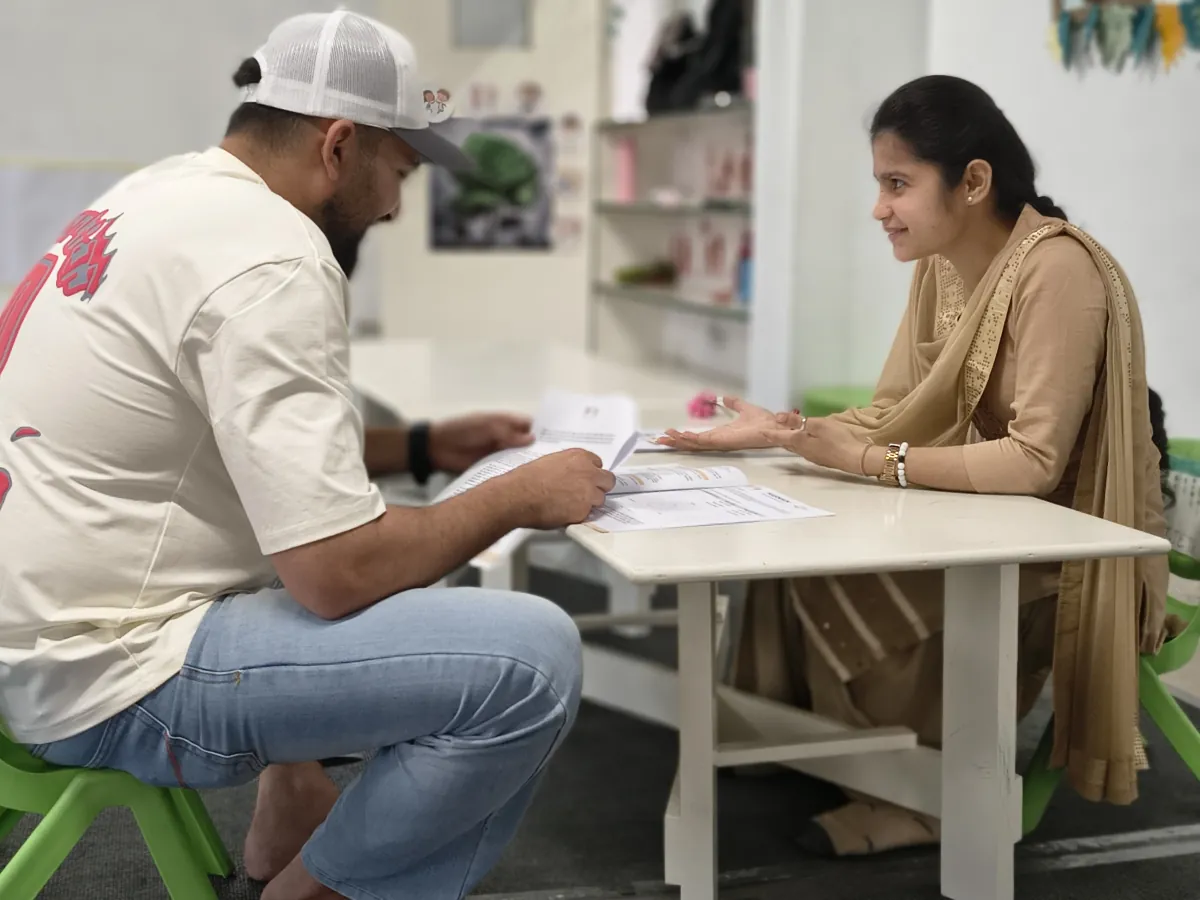
At a parent-teacher meeting here, each parent gets an hour. Not five minutes at a desk with a mark sheet, but an hour at a table with a facilitator and a year of notes about their own child. That meeting happens once a year, when the report is shared. In between, a parents' circle every month goes through the same noticing with all the parents together.
Parents come looking forward to one thing: reading what the facilitators saw. The lunch where their child counted the orange segments and took them away one at a time. The morning they waited for a turn without being told. Things a parent may not have seen at home, and things they have seen at home and now understand.
An hour is long for a meeting about a four-year-old. It is short for a year of watching.
And any morning between nine and one, you can come and watch for yourself.
The observation notes are from one child's Individual Progress Report, Nursery, 2025–26, with the name removed.