Kadam Experiential SchoolBaraut, Baghpat
Visit us
The questions we started with

Why Kadam exists

We started with questions, and we still ask them.

  1. Is the world fair for everyone?

  2. Are we moving towards a more beautiful world?

  3. Do systems of power fulfil their role?

  4. Why are wars, obesity, mental disorders, gender-based violence and communal violence increasing year on year?

  5. Why is our time being colonised?

  6. Why does an average CEO earn so much more than a security guard, when the gap used to be far smaller?

More children are in school today than at any point in history, and enrolment and graduation rates climb almost everywhere. And while they climb, the world is not getting kinder.

The purpose of education was to build a better world for everyone. Modern schooling has given us better medicine, faster travel, a phone in every hand, more women in work than in any generation before us. However, the isolation keeps growing, wars keep being fought, political and social polarisation keeps instilling hate. The question is sharper now, for children growing up with AI, with social media, and with wars they can watch on a phone.

What is the purpose of education?

Bright Spots

We are inspired by elders and by peer practitioners who nurture and nudge the world in and around them towards a more beautiful blossoming.

The wholesome practices of Mirambika Free Progress School, The Yellow Train School and Co-veda Learning Center, and organisations supporting learning like Kaivalya Education Foundation, Youth Alliance of India, Indian School of Democracy and Aarambh, among many more, have carved a path which gives us the courage (and internal safety) to ask the difficult questions above, and to reflect on how they show up in our lives.

We are also alive to our own difficulties: managing our emotions, consuming consciously, holding deep and nurturing relationships, managing conflict, managing money, and many more. We feel the multitude of challenges we are all facing, and we continue to work on ourselves.

The invitation we hesitantly dare to extend to the world is a community of practitioners: people seeking this path of sadhana, and building a learning community, usually known as a school, around that collective seeking.

For now, a few of us have come together to work on ourselves, and to create a conducive environment for our seeking, in the company of children.

We call it a socially driven school, which means only this: we say what kind of adults we hope to add to the world, and we build the school backwards from that. Today that is three classes on a college campus in Baraut, one year old, and everything on this site is something you can come and check.
Values – we are doing this by rooting ourselves in

Our vision is to nurture capable, compassionate and courageous individuals to reclaim home.

They come in an order, and each one depends on the one before it.

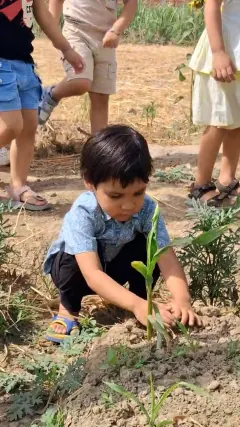
A child crouching in the field, both hands pressing the earth around a sapling, other children's feet around him.

Compassion is who you act for

Others are celebrated rather than tolerated. A child here grows up with a positive attitude towards people from different groups, and learns that action can go beyond self-interest: to other people, to nature, to all living things.

How it is observed
Self-talk, tone, how a conflict is handled, and a child's point of view on other religions, castes and genders.
How it is nurtured
An integral curriculum, with projects that improve the children's own neighbourhood: bringing a pond back to life, setting up a recycling system.
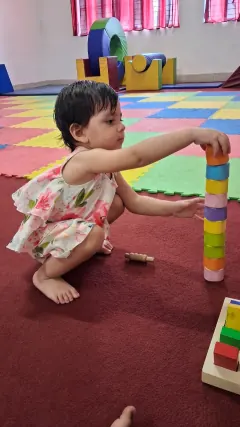
A small child crouching on a red carpet, reaching to place a piece on top of a tall tower of coloured wooden rings.

Capacity is what you can do about it

Project-based thinking, with a rooted मन, leads a person to look at what their own community needs in order to grow. A social enterprise. An energy solution. Something that makes a place easier to live in. Vocation stops being about earning and becomes contributing to a better life for everyone.

How it is observed
Real-life skills, such as woodwork, pottery, AI, finance and editing, that can grow into a righteous livelihood.
How it is nurtured
From Class 6, when we get there, vocational project-based learning that matures hobbies into real competencies.
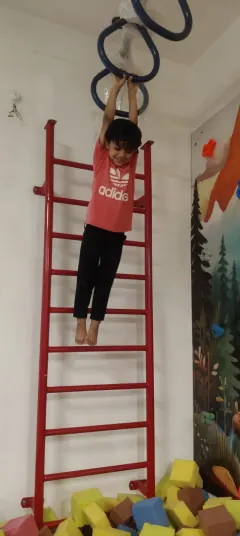
A child hanging by both hands from rings near the ceiling, above a pit of foam blocks.

Courage is whether you do it

It is the integrity question. The move from armchair activism, from telling other people what they should be, to a harder question: am I being who I want others to be?

It is also the one the adults hold themselves to first. The facilitators here want to be able to embody what we hope the children will embody. That is the whole of the job description.

How it is observed
Difficult choices, about food, clothing, career, religion, transport, politics and more.
How it is nurtured
Stories, systems thinking and projects that create real chances to choose, looking at how many times a child attempts, and how they speak about self, society and system.

Compassion sets the direction. Capacity supplies the means. Courage decides whether anything happens.

Three more, for the campus we are designing

The school that will be built behind the college, master plan from October 2026, is designed around three more, and none of them will have a sign explaining it.

Curiosity. Many small working sparks of it. A kaleidoscope. Things that help you see what you otherwise could not. Science that is relatable and useful and draws a child towards thinking like a scientist.

Play. The most natural part of being human. The space should invite children and adults, alone and in groups, to play, and play is not confined to a playground: a slide down the side of a stair, nooks and crannies, a place that asks to be used playfully. We often say everyone is less sad on a swing.

Absurdity. Something awkward, new, out of the ordinary, to break our patterns of thinking. A thing that feels out of place and makes you ask what is happening here, and what it might be causing.

We have a dream for a harmonious society for all sentient beings.

“A dream is not what you see in sleep, it is the thing that doesn't let you sleep.”

A. P. J. Abdul Kalam