Notes from school. 14 September 2026
How counting arrives
We do not ask children to recite numbers.
The 4 is a symbol. One, two, three, four are sounds. A child can learn both without either meaning anything, and repeat them back to stay out of trouble or to get an adult to look at them. That is not counting, and a child who can chant to a hundred may not be able to tell you how many bananas are on the table.
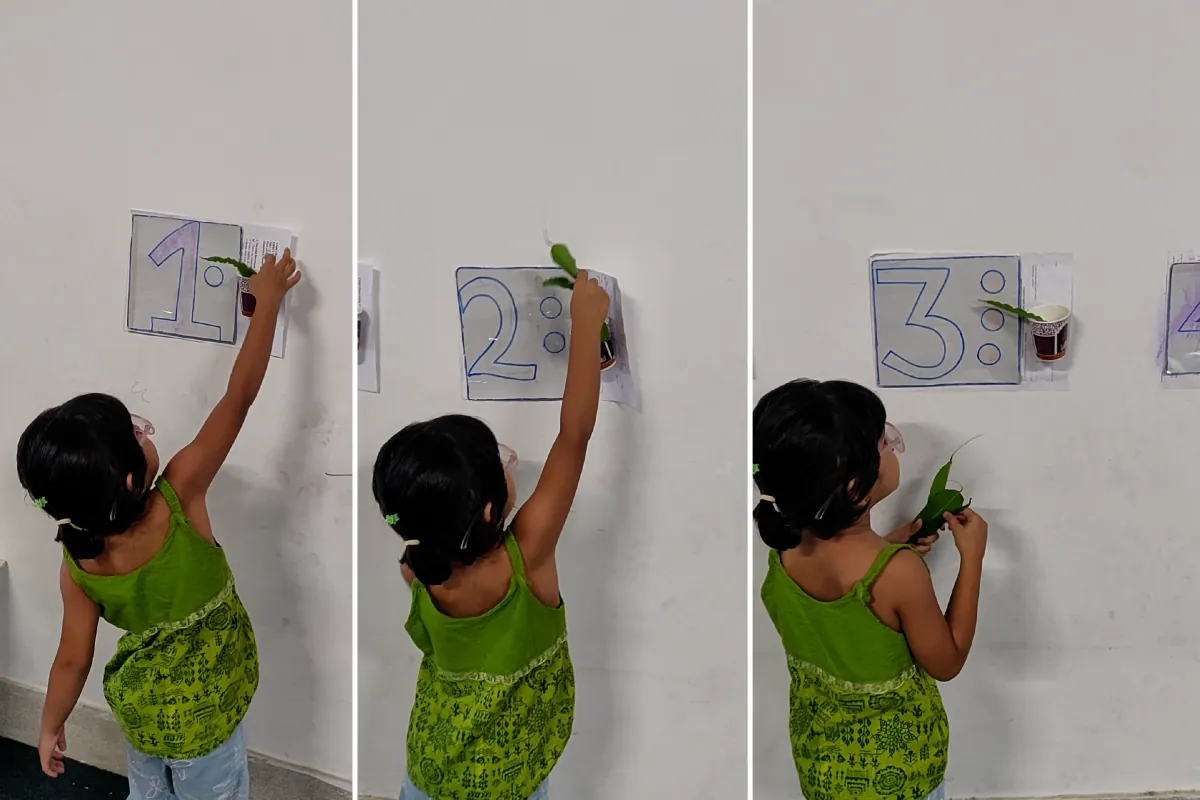
Numbers in the middle of ordinary life
So we start somewhere else. How many animals were in the story. How many things are on this page. How many bananas we have today, and how many children, and whether that is enough. Numbers turn up in the middle of ordinary life long before counting is introduced as a subject, and by the time it is, the children have been counting for a year.
वस्तु (गद्दी, बॉल, रंग भरकर बनाई गई आकृतिया) को 8 तक गिन लेता है। 8 से आगे भी गिनने की कोशिश करता है। कभी-कभी 10 तक सही गिनती करता है। अभी, गिनती याद रखने की जगह समझ विकसित करने पर काम हो रहा है।
He counts objects, cushions, balls, painted shapes, up to eight, tries past eight, and sometimes counts correctly to ten. For now the work is on understanding, not on memorising the count. A facilitator's note in one child's progress report, Nursery, 2025–26.
The last sentence of that note is the whole method. The facilitator could have drilled the count to twenty in a week, and wrote down instead that the work, for now, is understanding.
Big and small was a leaf hunt
One July morning, after an hour of Physical and a fruit break, thirty children went outside to look for leaves under the Ashok trees. Big ones and small ones. They helped each other find them, carried them back in, spread them out on the mat, sorted them, answered the facilitator's questions about them, cleaned up before the session ended, ran and jumped around them, and sang a song about them.
That was the maths lesson. Comparison, sorting and classification are where number sense begins, and a child who has argued with a friend about whether a leaf is big or small has done more mathematics than a child who has coloured in a worksheet of big and small. It was also thirty children moving their bodies for an hour, and a child noticing that a friend had not found a small one yet. We do not separate those.
Shapes arrive the same way. A child who knows a circle and a triangle puts them together, makes a train or a building out of them, and names it. Measuring arrives the same way too. When the facilitators measured a long jump in the sandpit, the unit was the hand span, five to five and a half of them, because that is a unit a four-year-old can see.
Adding and taking away, inside a story
Then we begin adding and taking away before counting has even settled, because a child can already work with more and less. Not "four subtracted by eight". Counting beads, moving the beads, counting again, making a story about the beads. Moving things around inside a story and asking the children what is left. Asking them to make their own story, with animals in it.
खाना खाते समय संतरे की फांके गिन कर बोला- “ये चार है”। फिर एक-एक कम करते हुए बोला- “अब तीन रह गई”, “अब दो बची”, “अब बस एक बची”।
Counting the orange segments at lunch, four, and then taking them away one at a time: now three left, now two, now only one. Nobody set him a sum. The same report.
That is subtraction, done by a child who has never heard the word, on the thing in front of him, because he wanted to. When the word arrives, it will land on something.
Concrete, pictorial, abstract
The order is always the same. Concrete first, in the child's hands: beads he can move, leaves he can sort, segments he can eat. Then pictorial, which is four birds and four dots, buttons and lines, number sense holding steady across shape and size. Then the symbol and the sound, last, once a child has met the need for them. The ४ and the 4 both come at the end.
A child who arrives at the symbol this way does not forget what it stands for, because it stands for something they have held. A child who starts at the symbol has nothing underneath it, and the trouble tends to show up years later, as a sum that will not come out and no way of knowing why.
What we hold it against
None of this is a private system. The numeracy goals of NIPUN Bharat, the NCERT Learning Outcomes and the National Curriculum Framework for the Foundational Stage are what we measure against, and they are the same measures used on every school your child might otherwise attend. The framework itself asks for exactly this: play, activity, concrete materials, and observation rather than written tests, in these years.
What we do not do is hand a child the symbol first and hope the meaning turns up. If you want to see the difference, come on a morning when there are oranges at lunch.
The observation notes are from one child's Individual Progress Report, Nursery, 2025–26, with the name removed. The leaf hunt was in July 2026, under the Ashok trees on the college lawn.