Notes from school. 14 September 2026
What we do differently, in six questions
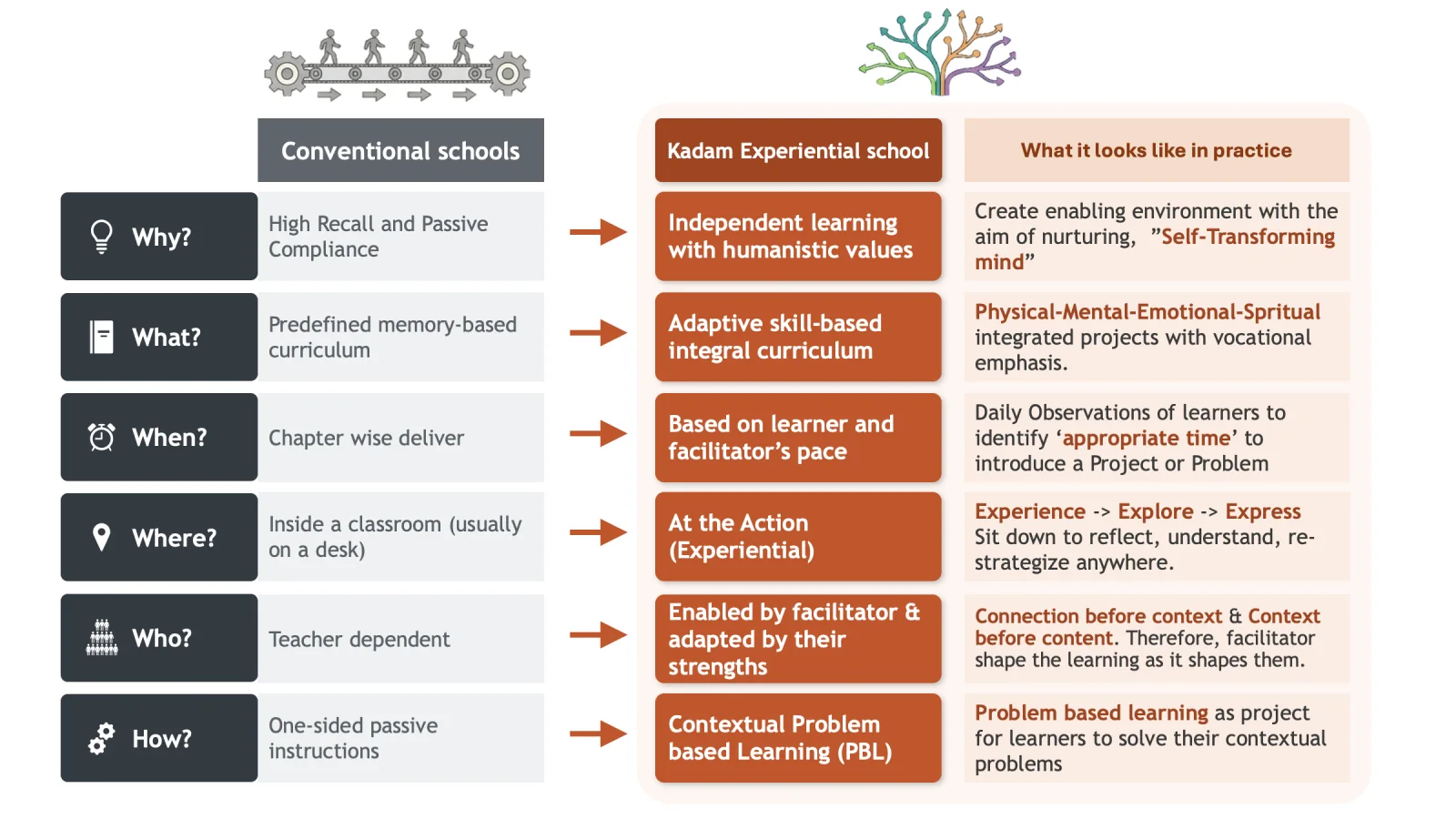
In April 2026 we drew a table for people who might help fund the school. One column was the school most of us went to. The other was Kadam. Six rows: why, what, when, where, who and how.
It is still the shortest honest account of the difference that we have, so here it is in full, with what each row looks like on an ordinary morning in Baraut.
Why?
The school we went to: high recall, and passive compliance.
Kadam: independent learning, with humanistic values.
Most schooling is built to produce two things: a child who can recall, and a child who complies. Both are useful. Neither is the point. What we are trying to build is an environment that nurtures what the developmental psychologist Robert Kegan calls a self-transforming mind: a person who can look at their own way of seeing things, and change it.
That is a long way off for a four-year-old. The habits that lead there are not. Choosing. Trying. Being wrong without being shamed for it. Asking why, and being answered with another question.
What?
The school we went to: a curriculum written in advance, built on memory.
Kadam: an adaptive curriculum, built on skills.
The physical, the mental and the emotional, the three in our name, worked through projects, with the spiritual underneath them and not written on any wall. The curriculum is written in pencil. It adapts to the children in the room, which is one reason there are three adults for thirty of them. From Class 6, when we get there, the projects will turn vocational, so that a young person leaves with skills they can earn a righteous living by.
When?
The school we went to: chapter by chapter, on the calendar's schedule.
Kadam: at the learner's pace, and the facilitator's.
Daily observation is how we find the right time to bring in a project or a problem. The 4 is a symbol, and a child meets it when they have counted enough oranges to need it. A chapter delivered on schedule to thirty children reaches the three who happened to be ready that week. How counting arrives is the long version.
Where?
The school we went to: inside a classroom, usually at a desk.
Kadam: at the action.
Experience first, then explore, then express. The lesson on big and small happened under the Ashok trees, with thirty children looking for leaves. The counting happened at lunch. The transplanting happened in the paddy next door, to the elbows in mud. Sitting down to reflect, understand and re-plan can happen anywhere, and it does, on the mat, in a circle.
Who?
The school we went to: the teacher, on whom everything depends.
Kadam: a facilitator, who enables, and shapes the learning with their own strengths.
Connection before context, and context before content. A child who is not yet with you cannot be taught anything at all, so the first job of the adult is the relationship. After that the facilitator shapes the learning and is shaped by it: one who sings brings singing, one who builds brings building. When a child gets something wrong, nothing happens. Wrong is an adult idea. A facilitator asks an open question, out of curiosity, and mostly avoids answering.
How?
The school we went to: one-sided instruction.
Kadam: problems from the child's own context, worked as projects.
A skill is worked through a project, and over the years the projects become problems: real ones, in and around the school and the children's homes. At four the problem is how many of these leaves are big and how many are small, and who has not found one yet. At fourteen it will be a pond to bring back, or what to do with the school's waste, and the children will have been practising on leaves for ten years.
What stays the same
A parent usually reads "no examinations" and hears "no syllabus". However, it is far from it. The syllabus is not trapped in chapters, it lives in skills. It is not evaluated through memory but observed through behaviour.
We also follow numeracy and literacy goals mapped to NIPUN Bharat, the NCERT Learning Outcomes and the National Curriculum Framework for the Foundational Stage, the same measures used on every school your child might otherwise attend.
The difference is in the how, the when, the where and the who. And in why we do it, which is the first row, and the reason for the other five.
Everything above is something you can come and check, any morning between nine and one.